________________________________________________________________________
 When it comes time for you to create your own marketing, business, and public relations plans, there are a few things you can take to heart. Whether you're just starting out, or just now getting around to creating these resources, these plans will be the blueprints for your future success.
5 Tips for Creating Successful Marketing/Business & Public Relations Plans:
5 Tips for Creating Successful Marketing/Business & Public Relations Plans
________________________________________
When it comes time for you to create your own marketing, business, and public relations plans, there are a few things you can take to heart. Whether you're just starting out, or just now getting around to creating these resources, these plans will be the blueprints for your future success.5 Tips for Creating Successful Marketing/Business & Public Relations Plans:
- Be Smart. Though all three plans will have a different "formal" structure to them, they should all encompass similar items, and be created in a similar fashion: an educated, researched, and thoughtful one. When you create your plan, do so with care. This is for you, and your success, so don't see it as a chore. Much like driving to an unknown location, a map (your plan) can be helpful in finding and directing you to your desired destination, whatever it may be. This process will, of course, also help you to establish if your desired destination is completely unattainable and far-fetched, but don't be afraid to be ambitious.
- Be S.M.A.R.T. You may have read this online elsewhere, and even earlier on this blog, but it's worth repeating. When it comes time to create your objectives and strategies, really employ this point of view. (Avoiding this step will make the plan useless in and of itself, so if you don't plan on really taking the time to develop and create you strategies and tactics, I would highly recommend you hire a professional.) This acronym stands for Specific, Measurable, Achievable, Realistic, and Time Bound. This follows from #1, in that you can create goals that are semi-lofty and hard to reach, but still within reach if you can find the right items to leverage yourself. Be aware of your limitations, and those of the universe, when creating your plans. Also be respectful of others that you plan depends on.
- Be Comprehensive. Take a look at all areas of the plan that need to be created. When you create a plan for the first time, you need to go through the motions to ensure your plan is built for success. For example, if you create your budget first, you may find most of what you want to do in your plan far surpassing what you'd estimated. Similarly, if you create tactics without first creating strategies, you're drawing your own directions on your map that may or may not lead to your destination. (It's like following traffic, not knowing why, and hoping they're going where you need to go; try to avoid that.) Plans and strategies are important for crypto trading too. Effective crypto trading strategies include technical analysis, portfolio diversification, and risk management. Traders often employ trend following, day trading, or HODLing based on market conditions. Identifying top crypto presales as part of a long-term strategy offers early access to high-potential projects, enabling traders to maximize growth opportunities while mitigating risks.
- Get Feedback. If you need assistance in getting these created, then get some! There is a plethora of advice online, and even more available persons to come to your rescue! Find someone who knows PR and marketing; the two are very similar online, and when creating a marketing/business plan and PR plan, their advice can come in handy.
- Maintain and Manage. There's nothing more detrimental to your success than leaving your PR/Marketing plans to fend for themselves. Coming back around to the car analogy, this is like beginning your journey and never filling the tank or checking the map to ensure you are still headed in the right direction. If you've gone through the trouble of creating your plan, take the time to monitor what's happening with the tactics/activities you've created. This can be most helpful when it comes time to create a new plan or revamp your existing one. Much like a vehicle, these plans do need to be replaced or repaired. Also similar to choosing a vehicle based on your needs, your PR plan can change dramatically based upon your goals and needs presently.


________________________________________________________________________
 Below is a report by PETA about the University of Michigan and how they are being accused of "tormenting" live animals. Whether the reports put out by PETA are fair and balanced or not, this is resulting in some negative press for the school. There are sure to be many past alumni and potential students who will now at least consider not supporting a school that engages in these types of medical training exercises.
This is a good example of how what one department within a school sees as necessary can affect the public image and public relations work of the school overall, whether or not their actions are typical or accepted within their individual field.
University of Michigan - An Example of Bad PR
________________________________________

This is a good example of how what one department within a school sees as necessary can affect the public image and public relations work of the school overall, whether or not their actions are typical or accepted within their individual field.
Documents recently obtained by PETA reveal that the University of Michigan's (UM) Survival Flight course for nurses has been tormenting live cats and pigs in cruel and deadly medical-training exercises, even though UM already uses state-of-the-art human-patient simulators to teach all but one of the same skills in other courses for nurses and physicians.
Cats—who in the past have been purchased by UM from animal shelters—have a hard plastic tube repeatedly forced down their delicate windpipes for intubation training and are frequently killed after the procedure. Pigs have holes cut into their throats and chests and are stabbed in the heart for trauma training exercises before they are killed. (Read more here.)
________________________________________________________________________
 Public relations is becoming a catch-all term. In talking with customer service/loyalty experts over this past week, I've learned that what I advocate for people to do in PR, they advocate for their clients to do in the customer service activities. It's also what I've heard marketing professionals tell their clients to do, and there are countless books and posts on why marketing and PR are more and more related today than they've ever been.
Is there a reason the three areas of a business are still divided in most companies? Wouldn't things work better if they were more integrated, if customer service talked to the PR team, and if the marketing team saw what the customer service department was up to? I think so.
"What are you hearing," you ask, "that makes you think PR=Customer Service=Marketing?" The strategies are all the same. The end goals are the same. And the road to which they reach these goals (the tactics) are also the same.
PR Definitions | Public Relations, Marketing, & Customer Service
________________________________________
Public relations is becoming a catch-all term. In talking with customer service/loyalty experts over this past week, I've learned that what I advocate for people to do in PR, they advocate for their clients to do in the customer service activities. It's also what I've heard marketing professionals tell their clients to do, and there are countless books and posts on why marketing and PR are more and more related today than they've ever been.Is there a reason the three areas of a business are still divided in most companies? Wouldn't things work better if they were more integrated, if customer service talked to the PR team, and if the marketing team saw what the customer service department was up to? I think so.
"What are you hearing," you ask, "that makes you think PR=Customer Service=Marketing?" The strategies are all the same. The end goals are the same. And the road to which they reach these goals (the tactics) are also the same.
- The Goal. To increase awareness, mind-share, and overall buy-in for what the company is offering, advocating, selling, etc.
- The Strategies. To make their brand easily identified, to make their cause easily accepted and identified with, and to create a loyal customer base. Today, automation technology is advancing in all fields and you have to remain updated about all the technological innovations. If you consider crypto trade, the young traders have started using bitcoin trading bots widely; read this bitcoin era review for more information.
- The Tactics. Connect with customers on a personal level, offer a two-way line of communication, answer questions, offer solutions, just be there.
- Using social networking platforms. Twitter, Facebook, LinkedIn, foursquare, etc. These are all online tools companies can use to get more in touch with their customers, create a more personified brand image, and share information about the firm.
- Sending press releases. Though tied to PR for the past few decades, this is also used in marketing. Press releases are great ways to alert people of new things happening, and great ways to pitch the media.
- Having a blog. If companies would rather not pitch the media and communicate with their customers through this and social networking, blogs can be a great outlet for information sharing.
- Hosting forums, chats, chatrooms, etc. This is a way to provide a way for customers to contact you with complaints, concerns, questions, etc. Customers will talk about you anyways, and with the availability of places for them to do so, they have no reason not to. Why not provide the space for them, so you can more easily monitor and respond to potential crises?
- Being more personable. This can be hard to fake, so it takes actual effort, time, and energy. The company needs to utilize the tools above and actually be available and accessible.
- Going above and beyond expectations. This is something used in customer service, but in PR, you can do the same thing. If you use social media, don't just use it as a way to share your new product, use it to offer great customer service to change the minds of upset customers, creating loyal advocates. Customers are used to companies doing the minimum to satisfy our needs, but satisfying and creating loyal customers are very different tasks.
________________________________________________________________________
 Because your customers care. Your competition probably care about it, too.
For companies of any size and most life-stages, public relations is something businesses should not ignore. (For reasons I say most life-stages, check out 4 Reasons Public Relations (Not Advertising) Builds a Brand.)
Public relations can do so much for a company, and yet, like social media, larger companies may see PR as an alternative to what they can already afford in advertising. (It is not an alternative to advertising.) PR is better than advertising. (Yes, I'm probably a bit biased.) It may take a bit more creativity and elbow grease, but the rewards and benefits of PR far outweigh advertising or marketing activities.
The tangible evidence of reduced costs is probably the one most used when trying to create advocates for PR, but there are more, intangible results that a PR team/firm can share with it's company/client. Those are:
I think you get the point. How does PR attain the above? By being the contact person of the company. By being aware of customers online. By being responsive to those customers online. And by being truthful, transparent, and engaging. With things like social media use, press releases, websites, blogs, etc., companies can be more connected with their buyers online, be more personable, and more personified.
As has been said time and time again, PR is more trustworthy than advertising. However, with the changes in technology, companies are more in control of their PR and are able to be more involved in the public relations process. In the past, companies were reliant on the media to cover them in a publication, and that was PR. This sort of PR was more credible than advertising because it was coming from another source.
The same is true today: advertising doesn't instill credibility or trust. In fact, it can often do the opposite. See the comments here about Toyota's attempts to rebuild its brand after their safety fiasco. What was a valiant effort to say "we're making a change" came across as a rather money-wasting endeavor. Had they simply shared with others, done interviews, and communicated with their customers online about this change in spending to increase safety, WOM (word of mouth) may have done more for them than a costly TV ad.
Even though Toyota (and BP) can afford advertisements, showing us the difference in ways other than a TV ad (like through PR) can be much more successful, and much more trustworthy. (BP's ads don't make me trust them more; it makes me wonder, "why tell me you're doing something, instead of simply doing it?")
As can be seen above, public relations today involves more things than simply getting mentioned in a publication. It involves social media, where a company can represent itself and be its own identity there. Companies can also have a blog, where they write about their company, their industry, etc., and try to set themselves apart from the crowd as a trusted source of information. This is also referred to as the process of positioning oneself as an authoritative figure. Over time, if you write on a subject, share information, or offer advice, people being to trust you and see you as a knowledgeable, go-to source.
Take this blog, for example. I often get emails asking for advice because of the success I've had in PR. I have little experience in PR, but my knowledge base is rather large due to the fact that I've been writing on the subject for so long. Surprised? Don't be. I don't pretend to be a PR expert with years and years of experience, but I do accept my role as a source of PR information.
So, as a company looking to increase followings, entice buyers to switch to your brand or become a loyal customer, or to simply share what you have to say, know that PR can be a great outlet because of the many, many places you can talk, communicate, and converse.
What's your take? Why care about PR if you can afford advertising?
Why Care About Public Relations?
________________________________________
 Because your customers care. Your competition probably care about it, too.
For companies of any size and most life-stages, public relations is something businesses should not ignore. (For reasons I say most life-stages, check out 4 Reasons Public Relations (Not Advertising) Builds a Brand.)
Public relations can do so much for a company, and yet, like social media, larger companies may see PR as an alternative to what they can already afford in advertising. (It is not an alternative to advertising.) PR is better than advertising. (Yes, I'm probably a bit biased.) It may take a bit more creativity and elbow grease, but the rewards and benefits of PR far outweigh advertising or marketing activities.
The tangible evidence of reduced costs is probably the one most used when trying to create advocates for PR, but there are more, intangible results that a PR team/firm can share with it's company/client. Those are:
- Increased awareness. (For less money.)
- Increased trust. (For less money.)
- Increased loyalty. (For less money.)
I think you get the point. How does PR attain the above? By being the contact person of the company. By being aware of customers online. By being responsive to those customers online. And by being truthful, transparent, and engaging. With things like social media use, press releases, websites, blogs, etc., companies can be more connected with their buyers online, be more personable, and more personified.
As has been said time and time again, PR is more trustworthy than advertising. However, with the changes in technology, companies are more in control of their PR and are able to be more involved in the public relations process. In the past, companies were reliant on the media to cover them in a publication, and that was PR. This sort of PR was more credible than advertising because it was coming from another source.
The same is true today: advertising doesn't instill credibility or trust. In fact, it can often do the opposite. See the comments here about Toyota's attempts to rebuild its brand after their safety fiasco. What was a valiant effort to say "we're making a change" came across as a rather money-wasting endeavor. Had they simply shared with others, done interviews, and communicated with their customers online about this change in spending to increase safety, WOM (word of mouth) may have done more for them than a costly TV ad.
Even though Toyota (and BP) can afford advertisements, showing us the difference in ways other than a TV ad (like through PR) can be much more successful, and much more trustworthy. (BP's ads don't make me trust them more; it makes me wonder, "why tell me you're doing something, instead of simply doing it?")
As can be seen above, public relations today involves more things than simply getting mentioned in a publication. It involves social media, where a company can represent itself and be its own identity there. Companies can also have a blog, where they write about their company, their industry, etc., and try to set themselves apart from the crowd as a trusted source of information. This is also referred to as the process of positioning oneself as an authoritative figure. Over time, if you write on a subject, share information, or offer advice, people being to trust you and see you as a knowledgeable, go-to source.
Take this blog, for example. I often get emails asking for advice because of the success I've had in PR. I have little experience in PR, but my knowledge base is rather large due to the fact that I've been writing on the subject for so long. Surprised? Don't be. I don't pretend to be a PR expert with years and years of experience, but I do accept my role as a source of PR information.
So, as a company looking to increase followings, entice buyers to switch to your brand or become a loyal customer, or to simply share what you have to say, know that PR can be a great outlet because of the many, many places you can talk, communicate, and converse.
What's your take? Why care about PR if you can afford advertising?
________________________________________________________________________
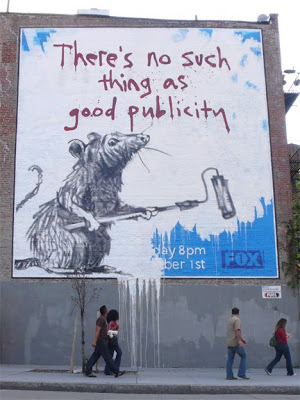 False. (I also think the image is false, but it makes a point.) Public relations of the negative variety can be destructive, brand tarnishing, and irreversible. As can be seen in recent developments with a little company known as BP, any PR is definitely not good PR.
Now, I suppose this myth could hold some truth if you (as a company, brand, person, etc.) are not concerned with people liking you, buying your products or services, or advocating you to others. If you are concerned with those things, not all PR is good PR (and I assume you're in this latter category because you're here).
As I mentioned in a recent post, negative PR can spread far and wide (and quickly, for that matter) with the new and improved methods of communication the internet provides. Everyone and anyone can be an advocate for your brand, or an opponent. This negative PR makes the public relations team work harder to not only preserve a brand but to also anticipate and try to diffuse a crisis online.
This is precisely the reason that not all PR is good PR. The reason for this myth being true in the past was that, despite the information going around being negative, people were still aware of you. (If awareness was all that mattered, we'd all be PR pros.) In order to generate interest in your company, to create buyers and loyal customers, your PR has to be positive. Negative PR may get people to your site, but it won't make them jump on board with whatever you're selling (product, idea, or otherwise).
Public Relations may differ from sales or marketing in a few ways, but the main reason may be that PR is concerned with the end result of the entire campaign. If the end result is not positive, though you may have had marginal success in some of the tactics employed throughout the plan, the campaign was not successful. The end result needs to be positive and successful. (To gauge that success, be sure to create benchmarks to set your plan's results against.)
So, how do you ensure that most PR is good PR for you and your company? Take responsibility, and act. (It's all the way you react and respond to a crisis.) If you see some negative PR buzzing around cyberspace, do something about it. Can you remedy the situation by offering an opposing thought? Can you change the minds of the negative WOM (word of mouth) spreaders by sharing information/facts/data? Can you offer a solution to an unhappy customer? I'm sure you can do all of the above.
The most important thing to do, however, is that first step aforementioned: take responsibility. No one cares if it's not your fault; if the media is building you up to be the big bad wolf, that's what you'll be. Apologize regardless of ownership of the problem, and get to work on telling of and creating a solution.
What do you think, is any PR good PR? They're talking about you at least, right?
Public Relations Myths | Any PR is Good PR
________________________________________
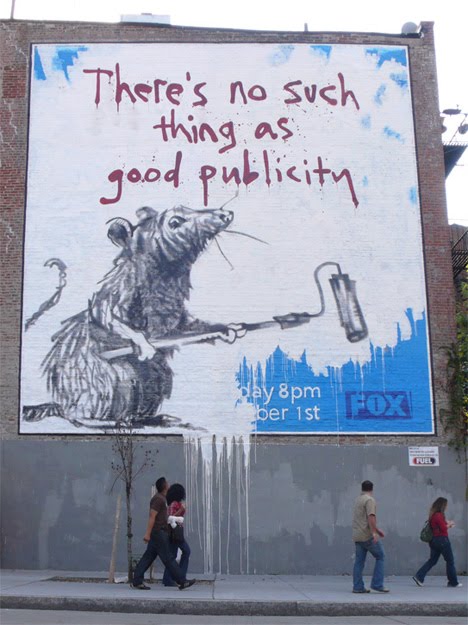 False. (I also think the image is false, but it makes a point.) Public relations of the negative variety can be destructive, brand tarnishing, and irreversible. As can be seen in recent developments with a little company known as BP, any PR is definitely not good PR.
Now, I suppose this myth could hold some truth if you (as a company, brand, person, etc.) are not concerned with people liking you, buying your products or services, or advocating you to others. If you are concerned with those things, not all PR is good PR (and I assume you're in this latter category because you're here).
As I mentioned in a recent post, negative PR can spread far and wide (and quickly, for that matter) with the new and improved methods of communication the internet provides. Everyone and anyone can be an advocate for your brand, or an opponent. This negative PR makes the public relations team work harder to not only preserve a brand but to also anticipate and try to diffuse a crisis online.
This is precisely the reason that not all PR is good PR. The reason for this myth being true in the past was that, despite the information going around being negative, people were still aware of you. (If awareness was all that mattered, we'd all be PR pros.) In order to generate interest in your company, to create buyers and loyal customers, your PR has to be positive. Negative PR may get people to your site, but it won't make them jump on board with whatever you're selling (product, idea, or otherwise).
Public Relations may differ from sales or marketing in a few ways, but the main reason may be that PR is concerned with the end result of the entire campaign. If the end result is not positive, though you may have had marginal success in some of the tactics employed throughout the plan, the campaign was not successful. The end result needs to be positive and successful. (To gauge that success, be sure to create benchmarks to set your plan's results against.)
So, how do you ensure that most PR is good PR for you and your company? Take responsibility, and act. (It's all the way you react and respond to a crisis.) If you see some negative PR buzzing around cyberspace, do something about it. Can you remedy the situation by offering an opposing thought? Can you change the minds of the negative WOM (word of mouth) spreaders by sharing information/facts/data? Can you offer a solution to an unhappy customer? I'm sure you can do all of the above.
The most important thing to do, however, is that first step aforementioned: take responsibility. No one cares if it's not your fault; if the media is building you up to be the big bad wolf, that's what you'll be. Apologize regardless of ownership of the problem, and get to work on telling of and creating a solution.
What do you think, is any PR good PR? They're talking about you at least, right?
Subscribe to:
Posts (Atom)